Actually building the table first - Ghana
Aug 25, 2026
Every origin we write about sends its best coffee away and hopes someone abroad notices. Ghana however is doing something we hardly seen anywhere else on the continent — selling it to Ghanaians first.
We named this blog after a feeling, a frustration, a obersavation... Africa grows the coffee, and Africa usually end up on the menu, rarely at the table where the decisions get made. It's also, we've realised, a bit passive. It waits for someone else to pull out a chair.
Ghana isn't waiting.
Start with what Ghana isn't
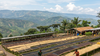
Ghana is a cocoa country. That's the whole global perception, and it isn't wrong — cocoa has carried the export economy for generations. Coffee has been grown there since the mid-1700s, but it has always been the other crop. When prices crashed in the 1980s, farmers pulled coffee out and planted more cocoa, which at the time was obviously the right call.
There's also a hard physical limit. Mount Afadja, the highest point in the country, tops out around 800 metres. Arabica wants far more altitude than that. Making Ghana robusta country, no amount of investment changes the topography.
Why Ghana grows robusta — the ceiling is the reason
Mount Nyangani, Zimbabwe2,595 m
Mount Elgon, Uganda4,321 m
Typical arabica floor~1,200 m
Mount Afadja, Ghana's highest point885 m
Ghana's entire landmass sits below the altitude arabica prefers. Not a shortfall - a different crop.
Then two things changed
First, cocoa started struggling. Harvests have been falling, climate pressure is real, and a country with one export crop under stress starts looking hard at a second one. Coffee stopped being the crop farmers abandoned and became the crop that spreads the risk.
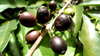
COCOBOD — the cocoa board, which also oversees coffee — has been pushing seedlings, inputs and replanting for years now. Roughly 17,000 hectares are under coffee, supporting somewhere around 8,000 smallholder families. Coffee has been named one of the tree crops the country wants to lean on to reduce its cocoa dependence.
Second, and this is the part that interests us far more: Ghanaians started drinking it!
Ghanaian coffee is on supermarket shelves in Ghana. Do you know how rare that is?
Go to most African origins and the good coffee leaves. What stays behind is instant, or the lots that failed export grade. The farmer has often never tasted their own crop brewed properly. We've written about this more than once, because it's the quiet insult underneath the whole trade.
In Ghana the café scene has moved past Accra into Kumasi, Takoradi, Tamale, Sunyani. Young people are opening shops. Roasting is happening close to the farms rather than six thousand kilometres away. There's an iced latte from a Ghanaian roaster, named after a beach neighbourhood in Accra, made with Ghanaian coffee and Ghanaian chocolate syrup — and it has become the drink visitors are told they have to try.
Read that again. Ghanaian beans, Ghanaian cocoa, a Ghanaian name, sold to Ghanaians and to everyone who comes home.
The chocolate showed them how
This didn't come from nowhere. Ghana has spent years watching bean-to-bar chocolate work - brands making the finished product at home instead of shipping raw beans to Europe to be turned into something worth ten times more.
And it's been reinforced by people arriving. The return of the diaspora to Ghana over the last several years has brought a market that wants the made-in-Ghana version. Someone who has flown in from Atlanta or London to reconnect with where their family came from is not looking for imported instant coffee. They want the thing that's actually from there. There are chocolate-making workshops in Accra now, aimed squarely at that visitor - roast, grind, mould your own bar, hear whose farm it came from.
Coffee is walking straight through the door cocoa opened.
We're not going to oversell it
Ghana's coffee sector is small and its robusta isn't yet widely rated as fine robusta. Berry borer damage still knocks quality and price down. Processing options are limited — much of it is sun-dried, and COCOBOD has been openly looking for partners to bring other methods in. Nobody serious thinks coffee is about to replace cocoa.
It doesn't have to. It has to be worth planting, worth roasting at home, and worth drinking where it grew. That's a lower bar than "export superstar," and it's a far more useful one.
What we take from it
We roast African coffee in Europe and send it to European homes. So we're on the export side of this, and we're not going to pretend otherwise.
But the lesson from Ghana isn't about export at all. Every origin we work with is trying to convince a buyer in Europe that their coffee is worth more. Ghana is quietly proving something else: an origin that drinks its own coffee has a price floor nobody in Amsterdam or New York can take away. When the domestic market is real, the export price stops being the only price.
That's not a country waiting for a seat at somebody else's table.
That's a country building its own.
Taste your way through the continent
A new African origin every month, roasted in small batches locally. Cancel anytime.
Start your subscriptionComments 0
Be the first to leave a comment.